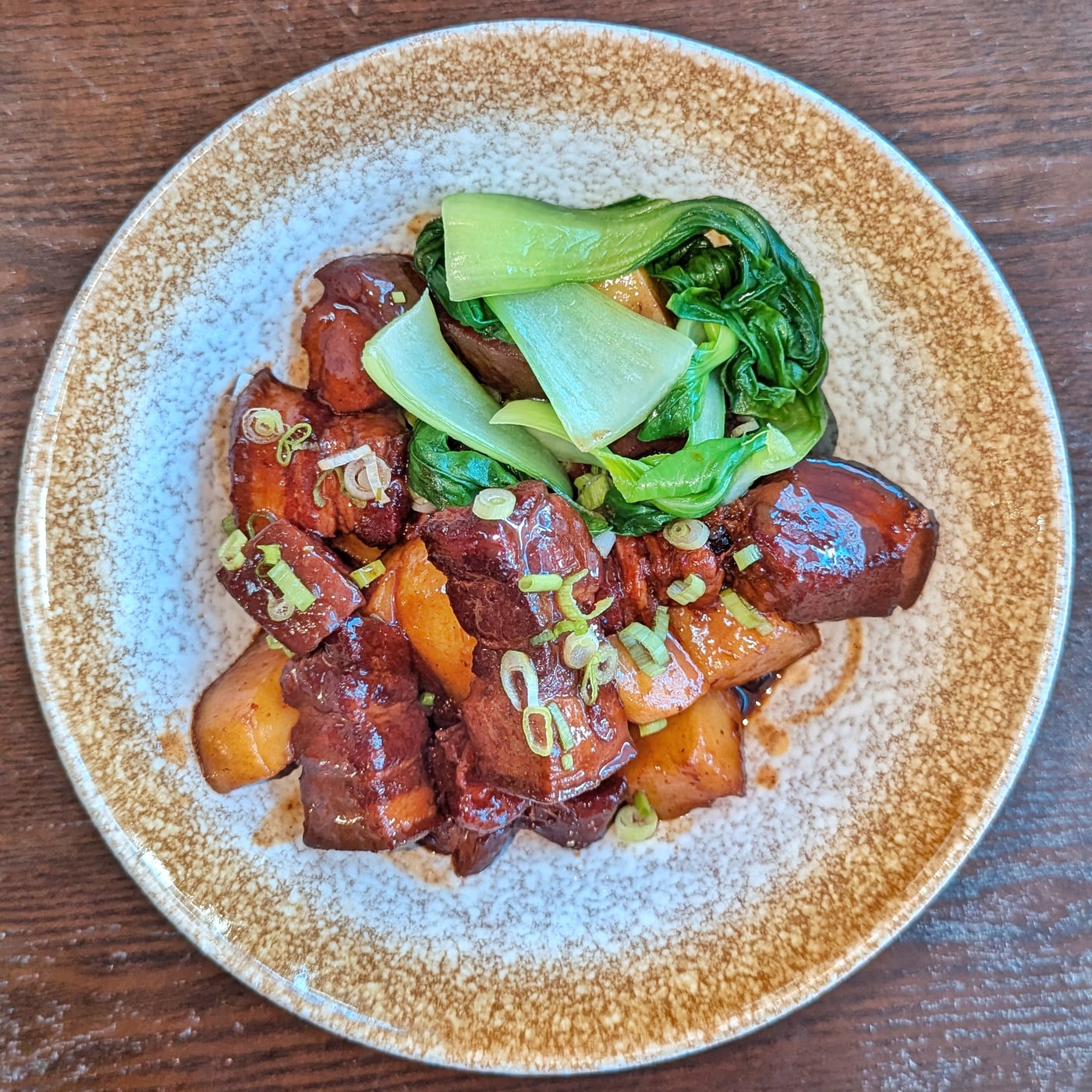
Chinese red-braised pork belly (hong shao rou) with sweet autumn chestnuts: pork blanched, glazed in caramelized rock sugar, soy and Shaoxing wine, then braised until melting under a glossy sauce.
Hong shao rou (红烧肉), red-braised pork belly, is the dish that defines Chinese home cooking: cubes of skin-on pork belly slowly braised in caramel, soy sauce and Shaoxing wine until the fat turns silky and the sauce clings like lacquer. This is the autumn version, 板栗红烧肉, with chestnuts added for the last stretch of braising. Chestnuts come into season in September and October, and they soak up the salty-sweet sauce while keeping a soft, floury bite that is a perfect foil for the rich pork.
A few details separate a great hong shao rou from a greasy one. Blanching the pork first pulls out the blood and scum, so the sauce stays clean and clear. Melting rock sugar into a light amber caramel before the pork goes in gives the meat its deep mahogany color, so you need very little dark soy sauce and the dish never tastes bitter or oversalted. Finally, the chestnuts go in only for the final 20 minutes; add them any earlier and they collapse into the sauce. The whole braise takes about an hour and a half, almost all of it unattended.
Ingredients
- 800 g (1 3/4 lb) skin-on pork belly, cut into 3 cm (1 1/4-inch) cubes
- 250 g (9 oz) cooked, peeled chestnuts (vacuum-packed), or 400 g (14 oz) fresh chestnuts in the shell
- 30 g (1 oz, about 2 tablespoons) rock sugar, lightly crushed, or granulated sugar
- 1 tablespoon vegetable oil
- 4 tablespoons Shaoxing wine, divided
- 2 tablespoons light soy sauce
- 1 tablespoon dark soy sauce
- 1 thumb-sized piece ginger (about 30 g / 1 oz), sliced, plus 3 extra slices for blanching
- 3 scallions, cut into 5 cm (2-inch) lengths, plus 1 finely sliced for garnish
- 2 star anise
- 1 small piece cassia bark or cinnamon stick, about 3 cm (1 1/4 inches)
- 2 dried bay leaves (optional)
- 600 ml (2 1/2 cups) hot water, or enough to just cover the pork
- 1/2 teaspoon salt, or to taste
- Steamed rice, to serve
Instructions
- Put the pork cubes in a pot with cold water to cover, the 3 extra ginger slices and 1 tablespoon of the Shaoxing wine. Bring to a boil over high heat, skim off the gray foam and boil for 3 minutes. Drain, rinse the pork under warm water and pat dry.
- If using fresh chestnuts, cut an X into the flat side of each shell, boil for 5 minutes, then peel off the shell and the papery inner skin while still warm. Vacuum-packed cooked chestnuts can be used as they are.
- Set a wok or heavy pot over medium-low heat and add the oil and rock sugar. Stir slowly for 3 to 4 minutes, until the sugar melts and turns the color of amber honey. Do not let it darken further or smoke, or the dish will taste bitter.
- Immediately add the pork and raise the heat to medium. Toss and turn for 3 to 4 minutes, until every piece is coated in caramel and the edges turn golden and start releasing fat.
- Add the sliced ginger, scallion lengths, star anise, cassia and bay leaves and stir for 30 seconds. Pour the remaining 3 tablespoons of Shaoxing wine around the edge of the pot and let it bubble for a few seconds, then add the light and dark soy sauces and toss to coat.
- Pour in enough hot water to just cover the pork, about 600 ml (2 1/2 cups). Bring to a boil, skim once more, then reduce the heat to the lowest setting, cover and braise for 60 minutes, stirring gently every 20 minutes. A chopstick should slide into the fat with no resistance.
- Add the chestnuts and salt and nudge them under the liquid. Cover again and braise for 20 minutes more, until the chestnuts are tender and stained brown by the sauce.
- Remove the lid, discard the star anise, cassia and spent scallions, and raise the heat to medium-high. Cook for 5 to 8 minutes, spooning the sauce over the meat, until it has reduced to a glossy glaze that coats each cube. Be gentle so the chestnuts stay whole.
- Transfer to a warm serving dish, scatter with the sliced scallion and serve with plenty of steamed rice.
Tips
- Choose belly with 3 to 5 even layers of fat and meat, and buy it in one thick slab so the cubes come out the same size. Ask for the skin left on; it turns gelatinous and sticky as it braises, which is half the pleasure of the dish.
- No Shaoxing wine? Dry sherry is the closest match. Rock sugar can be replaced with the same weight of granulated or brown sugar. If chestnuts are out of season, peeled hard-boiled quail eggs or chunks of taro added at the same point are traditional alternatives.
- Hong shao rou tastes different across China. For a sweeter Shanghai-style version, add another tablespoon of sugar with the soy sauces; for a Hunan-style version, add 2 or 3 dried red chilies with the star anise.
- If the sauce looks too oily at the end, tilt the pot and spoon off some of the fat before the final reduction. The next day the fat sets on top and can be lifted off in one piece.
- The braise keeps in the fridge for up to 4 days and tastes even better the next day. It freezes well for up to 2 months; reheat gently with a splash of water. If you plan to freeze it, leave the chestnuts out and add freshly cooked ones when reheating, since frozen chestnuts turn mealy.
- Serve with steamed rice or plain steamed buns (mantou) to catch the sauce, plus a sharp green vegetable such as stir-fried garlic bok choy or blanched Chinese broccoli to balance the richness.
Nutrition
Nutrition information is an estimate only: about 950 kcal, 20 g protein, 85 g fat, 26 g carbohydrate per serving, without rice.
Tap an ingredient to check it off
Updated